Monday, 16 September 2013

A typical D&T room - is that possible?


and many thanks to those of you who replied (see below for contributors).
So what did I find out?
Mainly that there’s a lot of ‘stuff’ in D&T rooms:
  • 3 x big old desks, band saw, scroll saws x 8, disc sander, jewellery trolleys, pillar drill, projector w. Apple TV, sink
  • 2 x lathe, milling machine, forge, pewter casting, 4 x old desks, pillar drill, band saw, projector
  • PCs on mezzanine + library, laser cutter, 3D printer, 5 x scroll saws, band saw, open plan desks, pillar drill, lathe, belt sand, Mobile whiteboard with projector + Apple TV, wall of whiteboards
  • 4 x open desks,18 x PCs, hand tools, laser & vinyl cutter, mobile white board + Apple TV + projector, sink, conf. table. Storage
  • Big screen. PCs. Technician. Lots of power sockets and space near by
  • Benches, stools and a timeline of machines & equipment with work crammed into any space available.
  • 11 double bench, ABC of DT, Keywords,3D letters-more coming soon
  • benching with vices for woods, metals, plastics. Organised tool boards, 2-3centre lathes, wood lathe, laser cutter, graphics equipment
  • One half woodwork benches and power tools, one half tables for 'designing'. Lots of safety notices. Lack of storage space
  • HDPE plastic collecting, machines, tool stations, spray booth- off cut box
  • metal/wood work benches, wood and metal lathes, tool cupboard, sander, pillar drill, laser cutter
  • 'hand tools/machines/laser cutter/work benches/wood & metal vices/
  • projector & whiteboard/laptops/display-exemplar work, levels & keywords'
  • student work of the week, articles, icons, ukdesigners, Old layout, new kit, dash of tech

But what’s missing from this list? There’s no mention of textiles technology, food technology and little related to systems & control. I’d really like to hear from D&T teachers who use these materials so I can add the detail to my research.
Hidden in these tweets were pedagogic ideas and the teacher’s personality:
  • mobile whiteboards, good reads, stories of past students, inspiration, quotes
  • create ideas with out designing
  • student work of the week
  • 1 big group table to share ideas
  • #accessFM#cafeque posters
  • ABC of DT – would be great if @patlink could share this
I loved this one:
  • @hardy_alison workbenches that subliminally trick students into thinking that the room is only for making! Old layout, new kit, dash of tech

It revealed to me the dichotomy that exists sometimes in D&T: do we make or design? And what do pupils prefer? (A blog post for another time).
And then things that made me sit up and smile about the uniqueness of D&T and its teachers:
  • teachers' current projects
  • technology, lots of it.
  • versatile, organised, enabling, inspirational, airy, robust, technological, evocative smelling, noisy, serious, welcoming...
  • lots of things that look like junk but are great learning aids
  • A DT room is another world.The smell, noise, machines, work space & atmosphere are completely different to any other classroom in the...school
  • A changing place learners want to be
(@misstreeteacher, @cdtMrHay, @mrcharlwood, @andrewhirstdt)
And finally one room had carpets - which strikes me as a luxury!
Many thanks to all of you who took the time to tweet to me – I’ll be putting together a blog post about your ideal D&T room soon.
Contributions from:
@mrcharlwood, @andrewhirstdt, @fitzpatrickjim, @patlink72, @tristramshepard, @CDTMrHAy, @DTteacher1001, @maghullhighDT, @cranny44, @misstreeteacher, @nohandsup
If i've missed you off - let me know and I'll add your name to the list.


Friday, 23 August 2013

Design decisions in D&T: asking 'Why?'


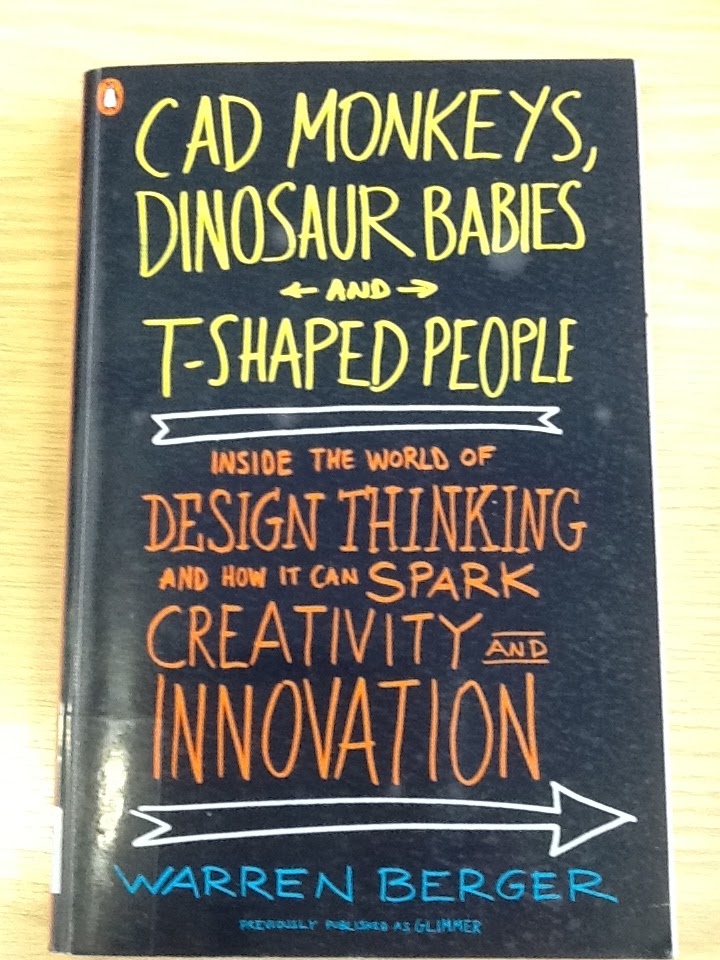
I'm reading a book by Warren Berger, CAD Monkeys, Dinosaur Babies andT-Shaped People, in preparation for the new term. Its a rich resource for D&T teachers but I'm going to focus on the questions we ask children when designing. As part of my MA I looked at questions in D&T and how they facilitate creativity. What came out of this research was that secondary D&T teachers tend to ask closed questions with a pre-determined answer.
In both the 2007 National Curriculum and the new version for 2014 D&T is defined, in part, as enabling pupils to be creative, take risks and solve real problems. One way of facilitating this is through the use of Why questions. This is a question 'favoured by inquisitive kids everywhere' (Berger p.25) but how can that be done in practice?
In D&T lessons in schools tend to play it safe, so that children have a successful completed product at the end of the project. This is a valid and commendable argument but I think it limits the design thinking which we say is a D&T strength.
If I think about how I might frame a design situation, I can either present the information and brief or through Why questions I can ask the class to explore a situation; I think this brings the situation more alive, making it real. At NTU I use the IDEO cards to encourage this design thinking, one of the hardest is the 'Five Whys' but its worth persevering with as you can really begin to understand what is at the heart of a design situation. 
To test out my argument I tried to write some why questions for a common design project I see in schools: the pencil case.
Q: Why do I need a pencil case?
A: To keep them neat and tidy in my bag and at home
Q: Why do I need to keep them tidy in my bag and at home?
A: Because the leak in my bag and my mum says I need to be tidy
Q: Why do you have a leaky pen?A: Because the lid comes off
 
Solution: redesign the pen! Much more interesting than a pencil case 
or: 
Q: Why do you need to be tidy?A: To help me be organisedQ: Why do you need to be organised?A: So I can find things 
Solution: explore what gets lost!
I'm not making any great claim about the quality of my questions. I think they are quite limited and false for two reasons:
  1. I'm out of practice at asking why questions
  2. The starting point of a pencil case as a design situation is false. In my opinion the pupils are making a pencil case not designing a pencil case. Think about it - what design decisions are the children making? Maybe the colour and decoration but unlikely to be the method of carrying, storing, opening, size, material or even who its for.
My questions begin to reframe the situation: its about being organised, keeping other people happy (Mum) and a poorly designed pen. With careful question and lesson planning children can be given more chance to make design decisions.


Listen to your questions:
  • Do you know the answer you want already?
  • Do you ask all of the questions?
  • Do they lead to discussion?
  • How many of them start with 'Why?'

Friday, 16 August 2013

Wikis: what we have learnt

We're into the final stages of preparing for the new term and I've just finalised the pre-course activites for new students on the D&T education course. This is the thrid one i've set up and each time I tweak it, hopefully making improvements. We've been using wikis at NTU for the past 4 years as part of the pre-course induction with our undergraduates. My colleague Sarah Davies initiated this in 2009 exploring the effectiveness of wikis as part of new student induction. She set up a wiki with ‘pre-entry’ activities such as getting to know you and joining a group. The wiki is useful for setting up online tasks prior to starting university. For our new students aren't able to access the university VLE as it they need to enrol first so the wiki (we use pbworks.com) is outside the university site. 

Although Sarah's findings indicated some students struggled with the wiki we persevered and three years later wikis are used throughout the course, not only for pre-course induction. We like wikis because they encourage collaboration which we see as a central part to learning in higher educaiton but also in design and technology.

We conducted research with the 2011 and 2012 cohorts of students using a framework from Salmon (2004). Salmon's work was primarily to do with online learning but her framework helped us understand the interactions taking place on the wiki and also develop our wikis. This has its own drawback s but on balance it works for us

This is the fourth year of using wikis as part of the pre-entry and through trial, error and research we've learnt:
  • keep the web address simple – a long web address can be off-putting
  • use the same format for each activity; the purpose of the task, what needs to be done, how to respond to others and using your time wisely;
  • keep each task simple, don't ask participants to do more than one thing at a time
  • plan the activites to scaffold collaboration online:
    • We encourage socialisation on the wiki in the first few activities: hello, who are you and join a group online
    • We link to the wiki during welcome week and in the first design assignment 
  • involve the whole team, lecturers, support staff and technicians
Want to read more about our work? Follow these links: